Skip to content
01Technology

The CNT sensor behind E-CNTShield.

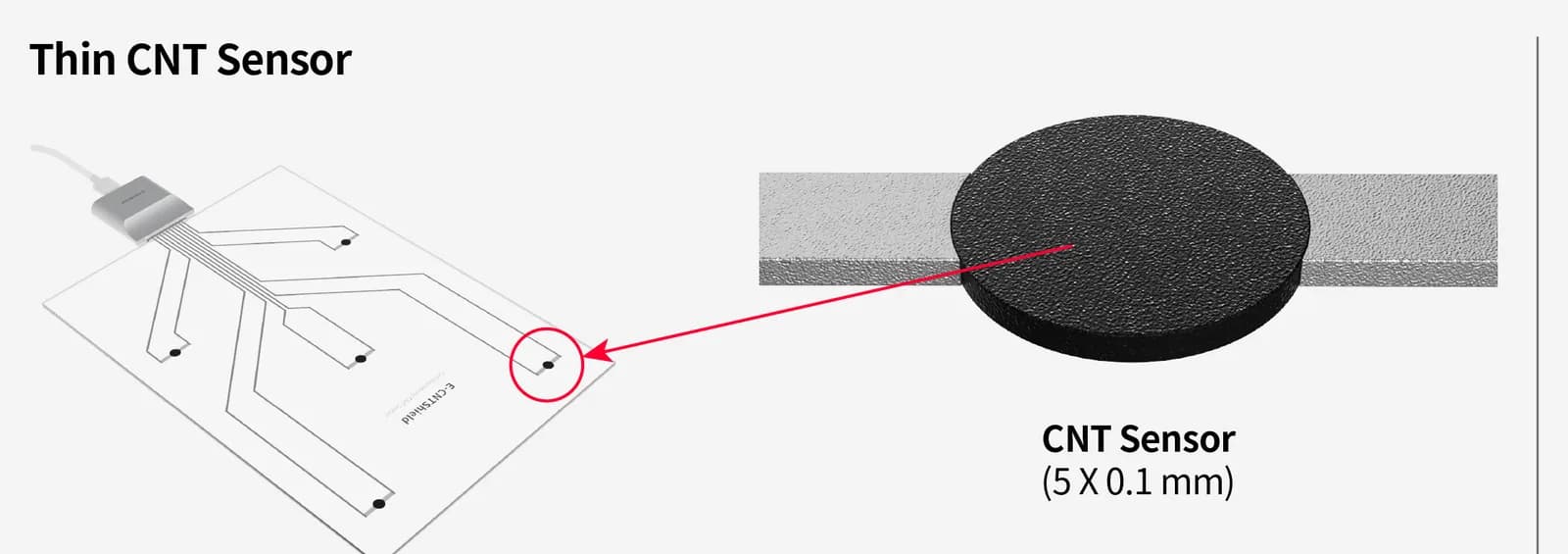
E-CNTShield attaches an ultra-thin CNT sensor to the battery cell to read pressure, temperature, swelling and impact. Software filters the collected data to support anomaly assessment and monitoring.

01.1How it works

Eight steps, from material to cell attachment, multi-parameter sensing and early-signal monitoring.

  1. Battery Cell

    The unit of monitoring is the cell, not the pack. Pack averages hide individual cell anomalies.

  2. CNT · Graphene

    Carbon nanotubes and graphene — carbon atoms bonded in a hexagonal lattice, with high strength and electrical and thermal conductivity.

  3. Ultra-thin Sensor Sheet

    40nm-class CNT material is formed into an ultra-thin, flexible sensor sheet that adds little weight or volume to the cell.

  4. Cell Attachment

    Applied directly to the cell surface. The flexible form follows the cell geometry.

  5. Impact · Pressure

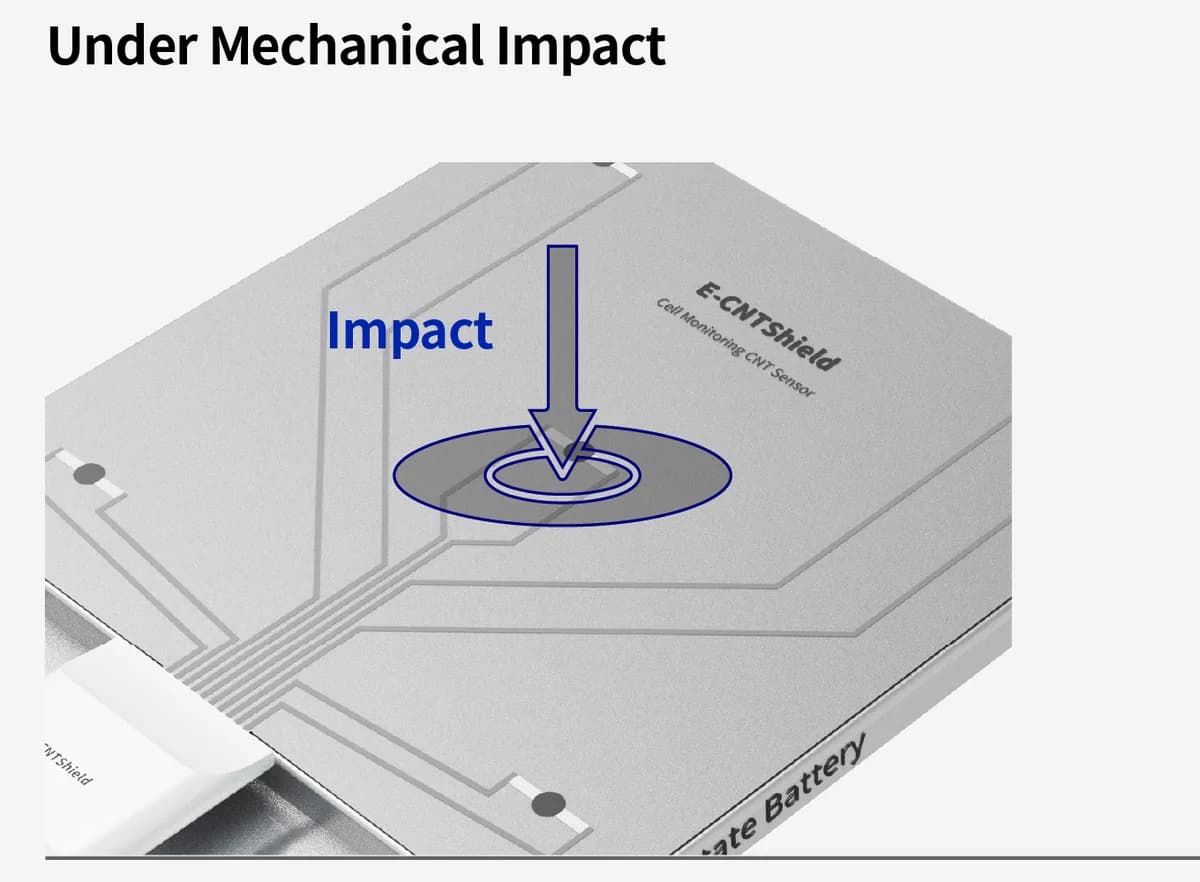
    Micro-scale physical distortion from external impact is read in the same layer.

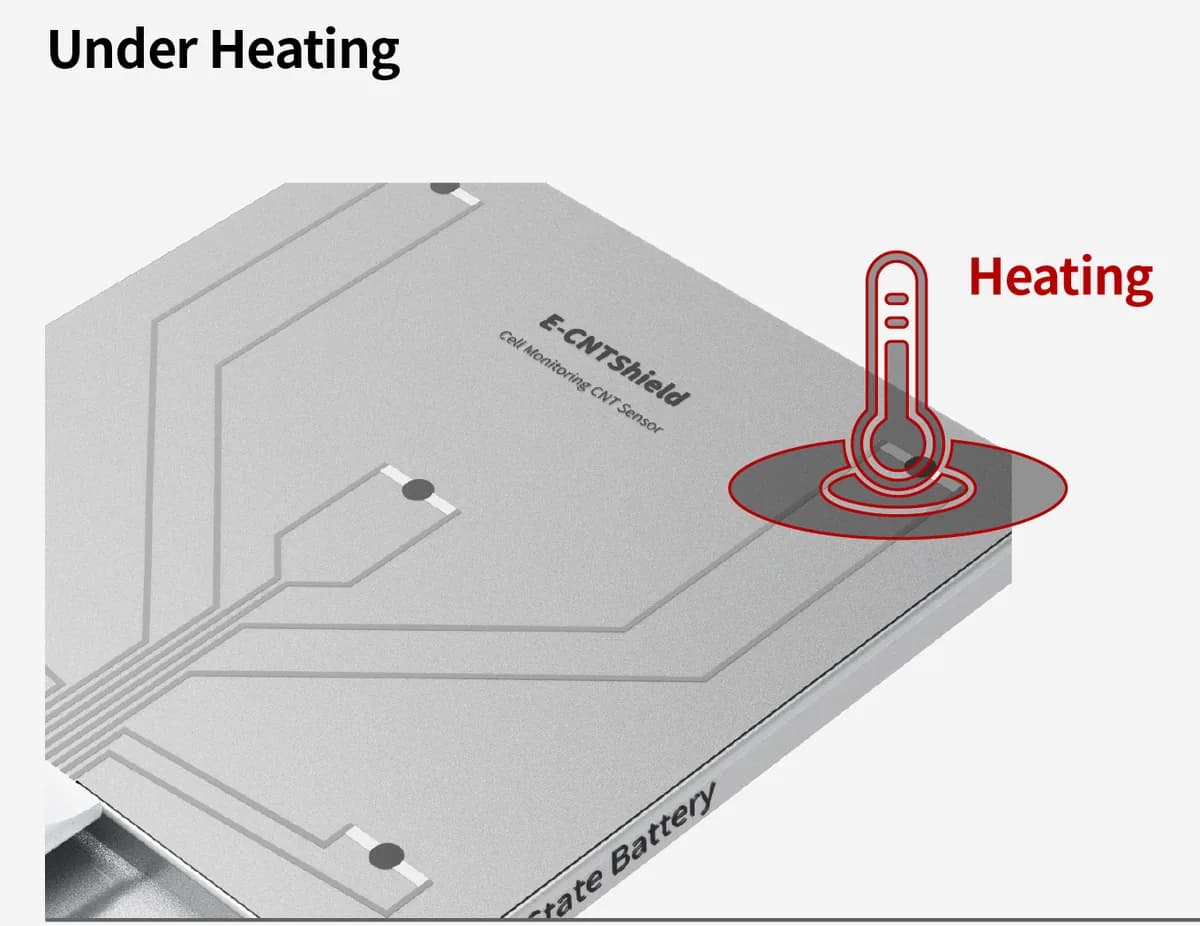
  6. Temperature

    Fine temperature change is tracked at the surface of each individual cell.

  7. Swelling

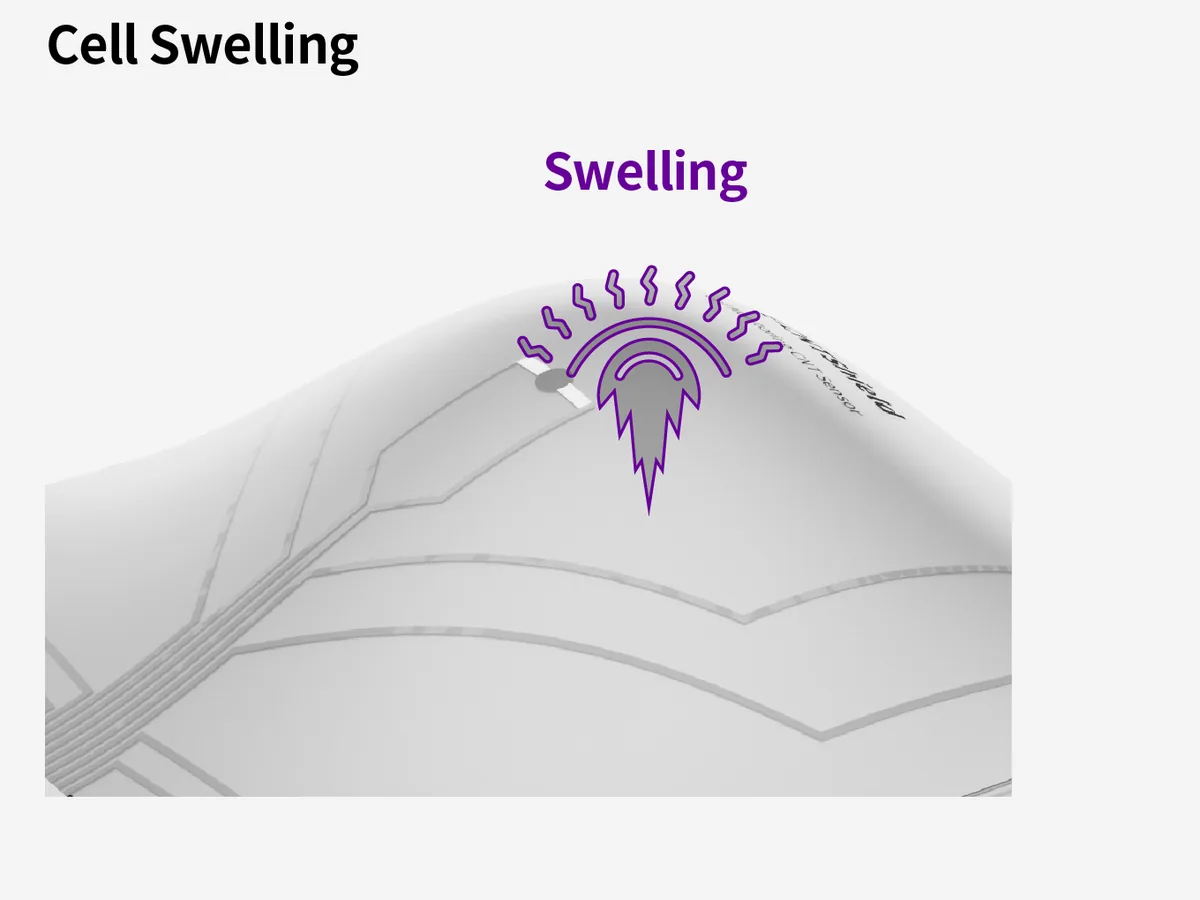
    Swelling — the cell expanding as it degrades — is detected as a change in form.

  8. Early Signal Monitoring

    Physical signals are combined and monitored as early indicators. We do not publish unverified detection times.

01.2What it senses

One sensor layer reads four physical quantities, and software filters that data into something you can act on.

  • pressure

    Pressure

    Pressure change acting on the cell.

  • temperature

    Temperature

    Per-cell temperature tracked in real time.
  • swelling

    Swelling

    Cell expansion and change in form read as a physical signal.
  • impact

    Impact

    Micro-deformation from external impact. All four quantities are collected in one sensor layer.
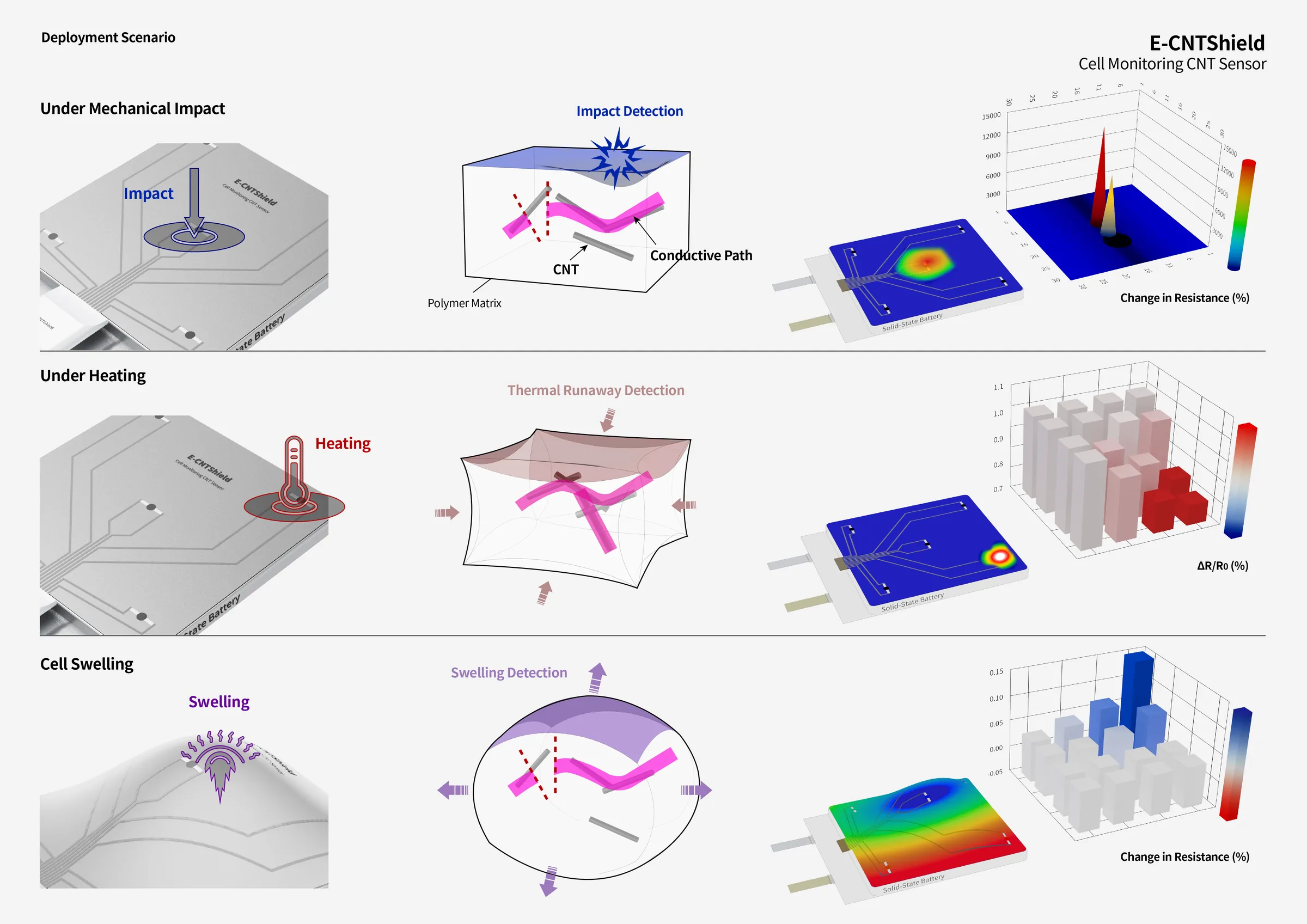
Deployment scenario: impact, heating and swelling each deform the CNT conductive path, read as resistance change across the sheet
Fig. 01Impact, heating and swelling each deform the CNT conductive path inside the polymer matrix. The sheet reads that as a local change in resistance.
01.3CNT material · sensor sheet
  1. CNT · Graphene

    Carbon nanotubes and graphene — carbon atoms bonded in a hexagonal lattice, with high strength and electrical and thermal conductivity.

  2. Ultra-thin Sensor Sheet

    40nm-class CNT material is formed into an ultra-thin, flexible sensor sheet that adds little weight or volume to the cell.
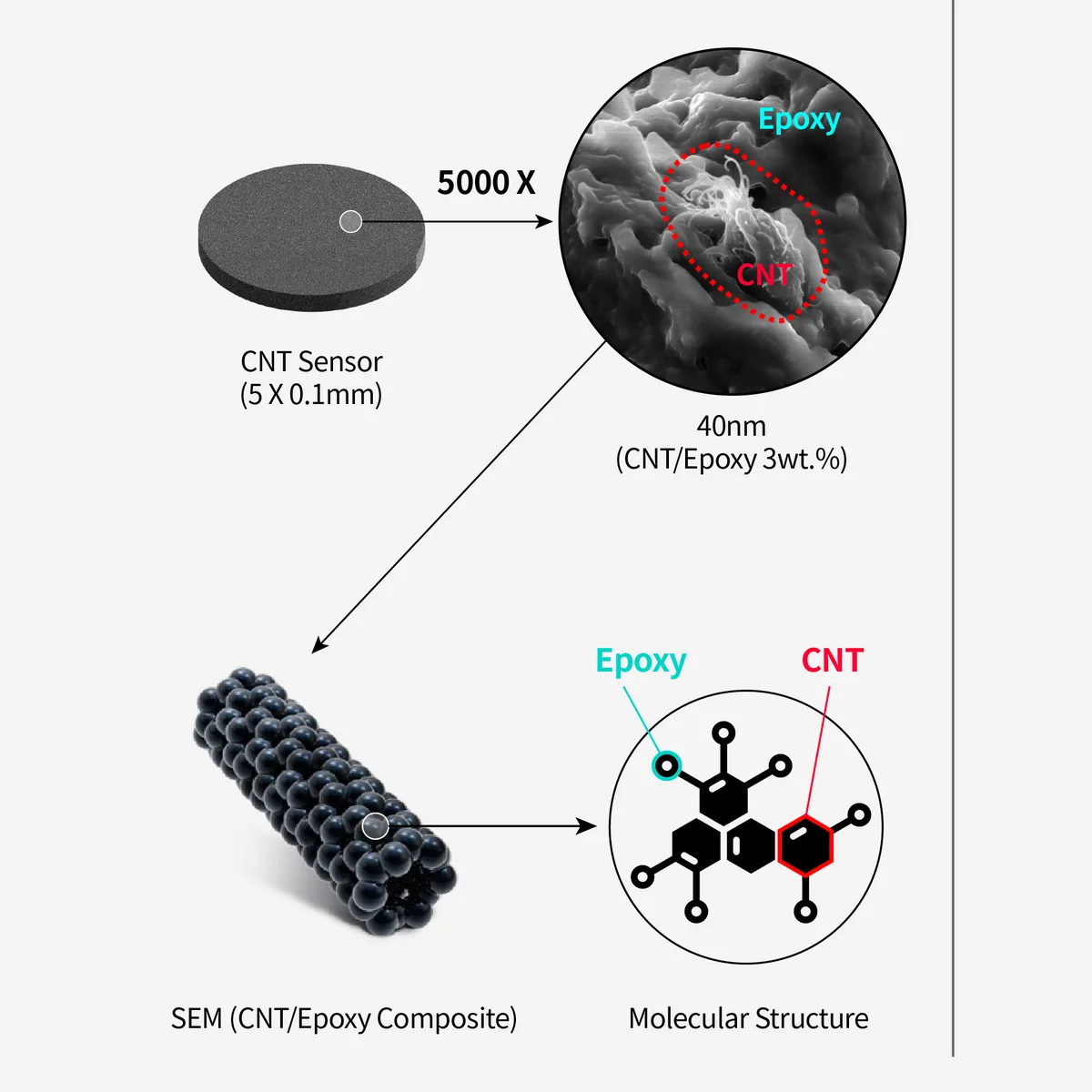
  • CNT sensor cross-section and SEM structure
    Fig. 02CNT sensor cross-section and SEM structure
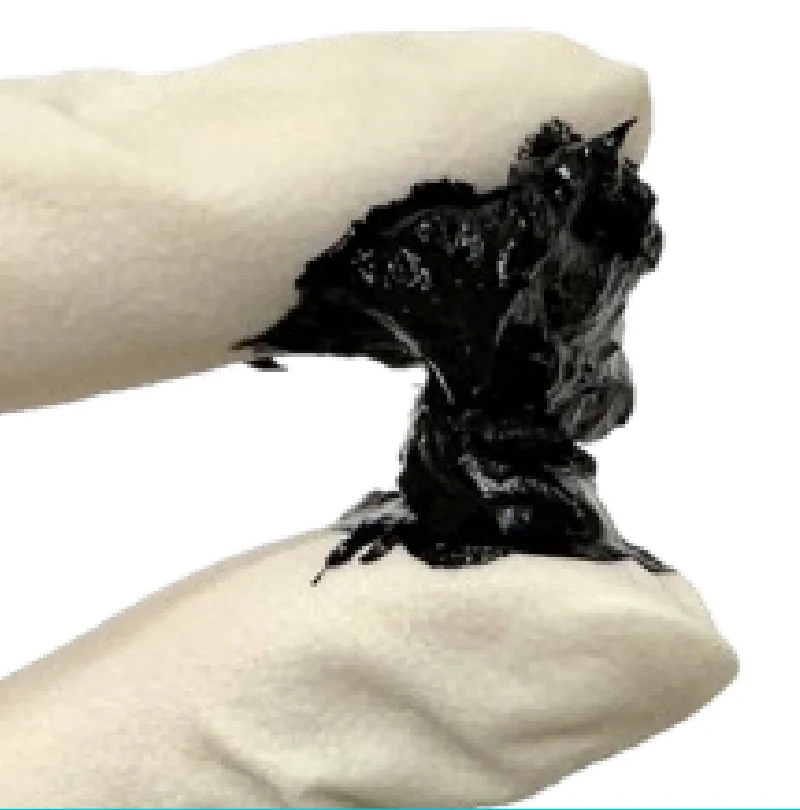
  • CNT/epoxy ink
    Fig. 03CNT/epoxy ink
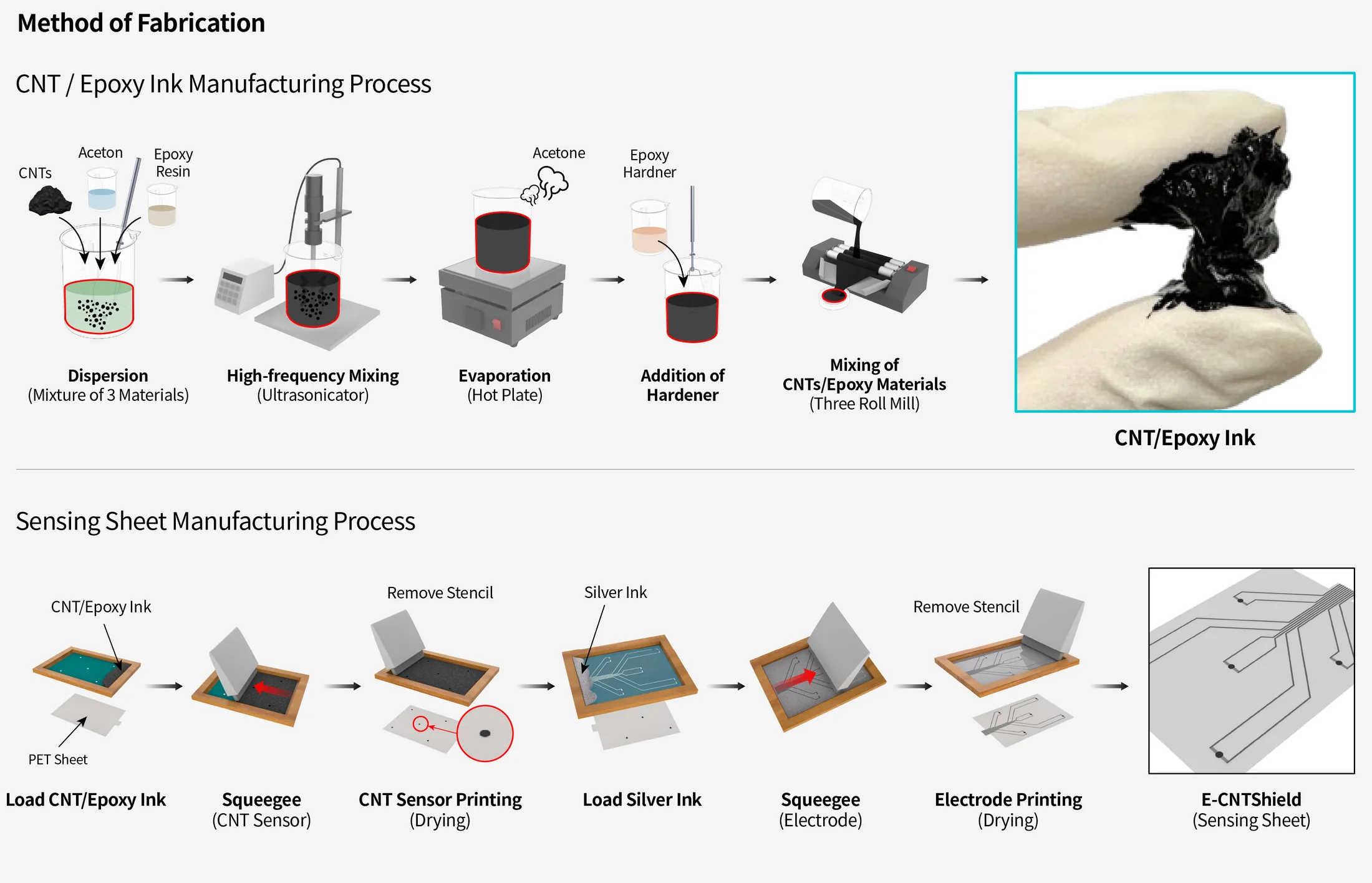
Fabrication: CNT/epoxy ink manufacturing process and screen-printed sensor sheet process
Fig. 04CNT/epoxy ink is dispersed, mixed and milled, then screen-printed together with silver electrodes into the sensor sheet.
01.4On real cells

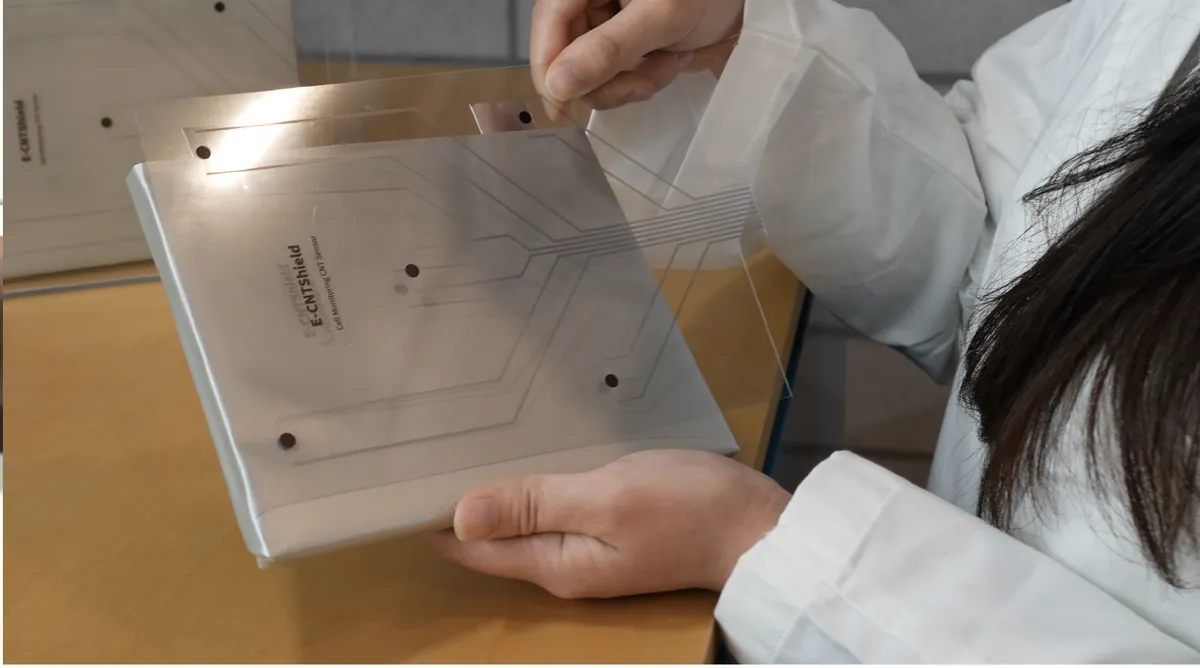
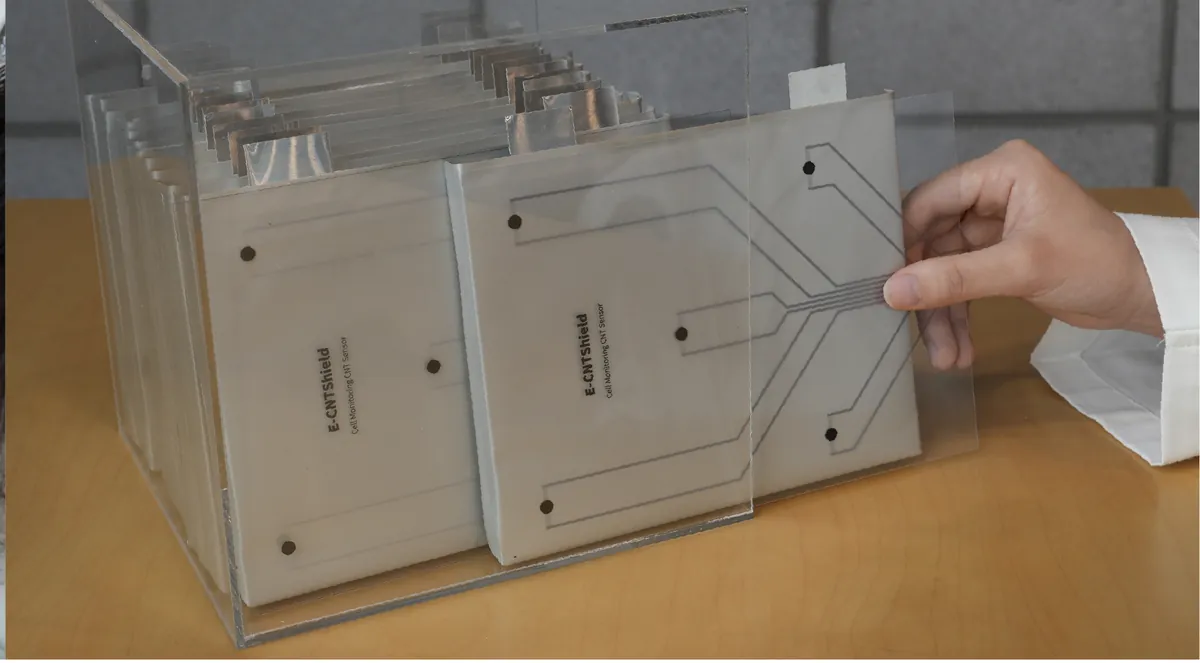
Lab photographs of the printed sheet, its adhesion to a battery cell and its placement between cells in a module.
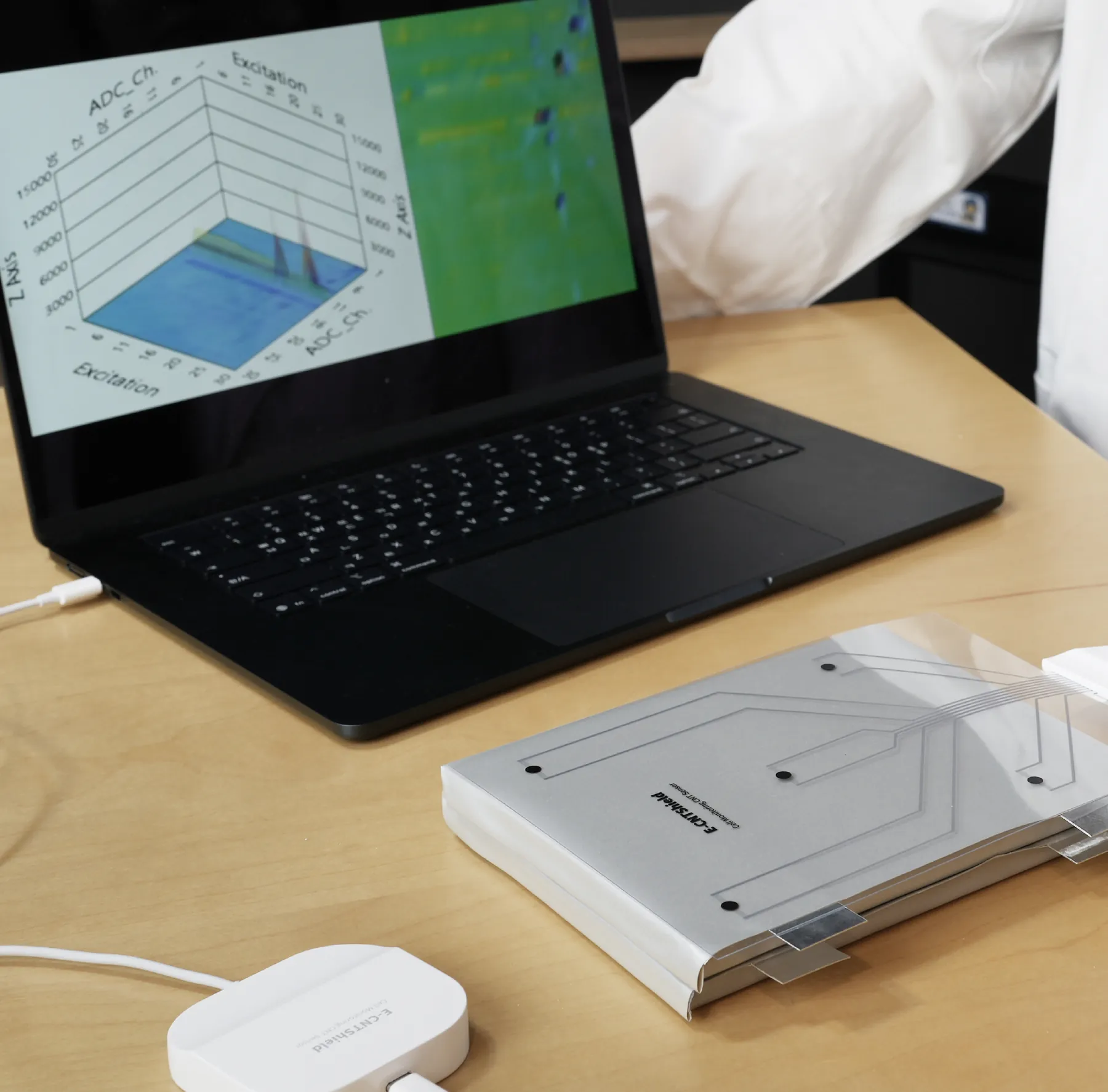

E-CNTShield sensor sheet on a battery cell, with its resistance map on a laptop
  • Printed E-CNTShield sensor sheet
    Printed sensor sheet
  • E-CNTShield sheet being attached to a battery cell surface
    Attached to the cell surface
  • E-CNTShield sheets placed between cells in a battery module
    Placed between cells in a module
01.5Core capabilities

Sensors capture it. Software makes sense of it.

  • 01

    CNT- and graphene-based ultra-thin sensor

    • 40nm-class CNT and graphene nanomaterials
    • Ultra-thin flexible sensor form
    • Attaches directly to the battery cell
  • 02

    Multi-parameter monitoring

    • Combined pressure, temperature and form sensing
    • Per-cell monitoring rather than pack-level
    • Real-time anomaly indication
  • 03

    Smart filtering algorithm

    • Noise rejection in harsh environments
    • Multi-sensor data fusion
    • Designed to minimize false readings
  • 04

    Edge computing

    • Low-latency local processing
    • Compatible with ESS, EV and humanoid platforms
    • Cloud data integration
01.6Business Model

Sensor modules go first to sites where safety management is most urgent, then expand into a subscription service that monitors battery condition in real time, with a data platform on top.

  1. 01Sensor
  2. 02Edge
  3. 03Monitoring
  4. 04AI Analysis
  5. 05Dashboard
  6. 06Data Platform